
Water Purification
is a vast field covering all the steps after sewage waste water or other waste water has been processed and sanitised and until it is returned to a field as irrigation or a river / piping network and the treatment plant for further processing as potable water.
Whereas hard water or soft, aggressive water are not really seen as filtration steps, it is vital in any water purification process that ph stability is addressed .
Water Purification Steps
All water treatment starts with coarse filtration. Large solids are removed and when we talk about large, this can be anything from a piece of paper, twig, gravel, algae, hair or clearly visible content …right down to particulate matter that cannot be seen.
To better illustrate what a micron is, lets look at a comparison that we can all relate to…..1 micron is equal to one millionth of a meter, or 0.001 mm or 0.000039 inches. There is no precise value for the thickness of human hair in micrometers. The diameter of human hair is proved to range between 17 μm to 181 μm. 1 micron, by the way, is the “size scale and below at which bacteria are found “

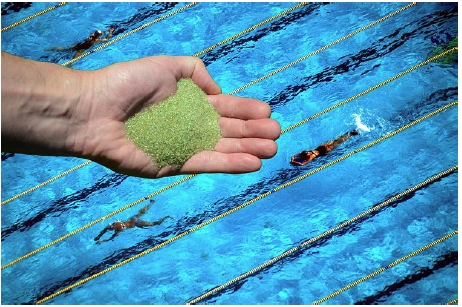
Coarse water filtration can take the form of a bar screen, sieve or one of numerous kinds of sediment removal filters. A common example of a sediment filter would be a swimming pool sand filter, which removes particulate matter at the range of approximately 20 microns.
Newer technology has now replaced the sand filter with glass media or natural elements known as zeolites, such as Clinobrite commonly found in Swim Pool Shops.
AFM Glass Media is the best glass media product available, but it comes at a premium price, approximately R1050 ex vat per 25kg.
We have a detailed data sheet on both products so please use the form on the top of the page to request the brochure and we will send it to you
QUOTE FROM SCOTTISH WATER
“Scottish Water tested AFM®, the results demonstrated significant performance advantage over sand in relation to suspended solids/iron removal and process efficiencies. I can also confirm that Scottish Water has been using AFM® for targeted effluent treatment for some 14 years with considerable success in the removal of solids and BOD reduction.”
Mark Haffey, R&D Technical Leader, Technology & Innovation Scottish Water

There are other cheaper versions on the market which we have not tested so we are not prepared to comment on their performances. Crystal glass is not AFM
AFM® is used for the treatment of drinking water this includes water from the following sources;
• Reservoirs.
• Lakes.
• Rivers.
• Springs.
• Boreholes.
• Brackish water and seawater prior to desalination membranes.
• Wastewater to be recycled as potable water.
AFM is normally not supplied in cartridges, as it requires a bed depth of more than 1 m in height to be effective. It also requires backwashing and most cartridge based installations do not have this ability.
Clinobrite the locally mined zeolite under the well respected Pratley brand , on the other hand, we have tested extensively at holiday homes on the Vaal river, where the source water, be it river water or borehole water, is often the colour of an old army boot – dark and dirty brown. Small amounts of 50kg cleans the suspended solids so that the resulting water looks like municipal tap water. This media is also designed to be used in a pool sand filter tank or FRP vessel, as filter media bed depth is very important with very high suspended solids levels. This media is much more affordable at approximately R385 ex vat per 25 Kg .
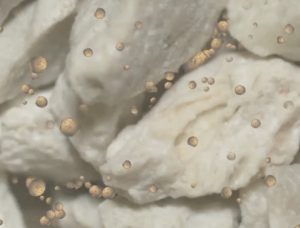
Clinobrite grains attract and trap extremely fine dirt particles and algae onto their surface and not just between the grains like ordinary sand.
A Clinobrite filter can remove 40 – 50% more physical dirt than an outdated sand or even a more modern glass filter.
It can also filter out much smaller particle sizes than sand or glass (without added aeration). This greatly improves the clarity of your water and gives much longer service cycles between backwash operations. Clinobrite is even able to trap the tiny cysts of “diarrhea causing cryptosporidium which are becoming a health problem in waters worldwide!
While Clinobrite was never intended for drinking water purification specifically and rather pool filtration, it has remarkable ability when used for potable water under specific circumstances.
A great benefit of this media is that on termination of its life cycle it can be used as a compost and recycled . When used in conjunction with inline chlorination for potable water sanitation it can be regenerated with table salt and brought back up to strength.
Easy Water Solutions provide both media types, which are suited for different applications. Speak to us before you make your final decision so that we can best advise you on the most effective use of either media types.
For domestic water purification use, small scale filtration cartridge filters are used. These come in the form of polyspun filters which are made by blowing hot polpropylene resin onto a cold spindle that rotates forming a spun filter element.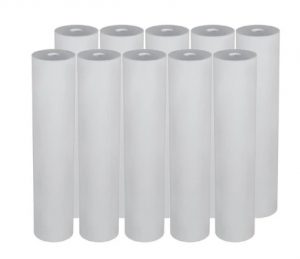
These water filter elements range in size from 10 inch through to 30 inches in diameter and height. Graded as standard and Big Blue or jumbo.Media filters packed in fiber reinforced cylinders known as FRP vessels are also common. These FRP vessels are also used to handle other filter media which react with the water in different ways, not just for sediment removal.
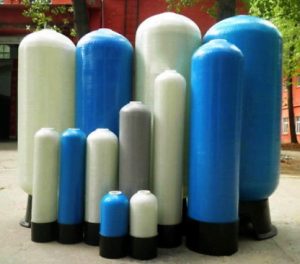
What determines whether a cartridge or FRP vessel is used is the flow volume and speed of the water flowing through the proposed filter combined with the particle loading of the water to be processed.
Particle loading and type of sediment are usually determined by a water analysis which is done by a certified water analysis laboratory. In South Africa
those labs are listed by SANAS The SA National Accreditation System
In a home, for instance, polyspun or melt blown cartridges are common for drinking water sediment removal, particularly in small kitchen under counter filter units.
The next stage after coarse particulate removal depends on the application. In waste water treatment that would be a settling tank where the water is left for a period of time so that any suspended solids can settle out before being transferred to the next phase . Unless the water is extremely dirty this settling phase is skipped in domestic water treatment and the water would then pass through a carbon filter of which there are 2 main types.
GAC or Granular Activated Carbon is normally the first filter after coarse sediment removal. GAC water filters are a tested choice to remove specific groups of chemicals, particularly organic chemicals, from water. GAC filters also can be used to remove the chemicals that give objectionable odors or tastes to water such as hydrogen sulfide (rotten eggs odor) or chlorine.
Molecules associated with living organisms are organic. These include nucleic acids, fats, sugars, proteins, enzymes, and hydrocarbon fuels. All organic molecules contain carbon, nearly all contain hydrogen, and many also contain oxygen.
-
-
-
-
- DNA
- table sugar or sucrose
- benzene
- methane
- ethanol or grain alcohol
-
-
-
The second type of carbon water filter is the carbon block or carbon taste and odour filter, CTO for short. This is a highly dense, compressed cylinder of carbon powder .
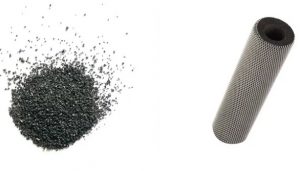 With a very good flow rate and high volume ability to process water, it is very popular amongst water filter suppliers. Carbon block water filters have a much larger surface area, which allows them to process a much larger quantity of water while also being much more effective at filtering out finer particles which would escape the granular form, heavy metals and other contaminants.
Where waste water differs from potable water purification is the necessity in waste water treatment to apply natural bacterial treatment as can be seen in our section on septic tanks and septic systems.
The coarse sediment removal and carbon filter stages are then followed by a much finer suspended solids removal process. Either Ultra Filtration, Nano Filtration or Reverse Osmosis . See the chart below ..
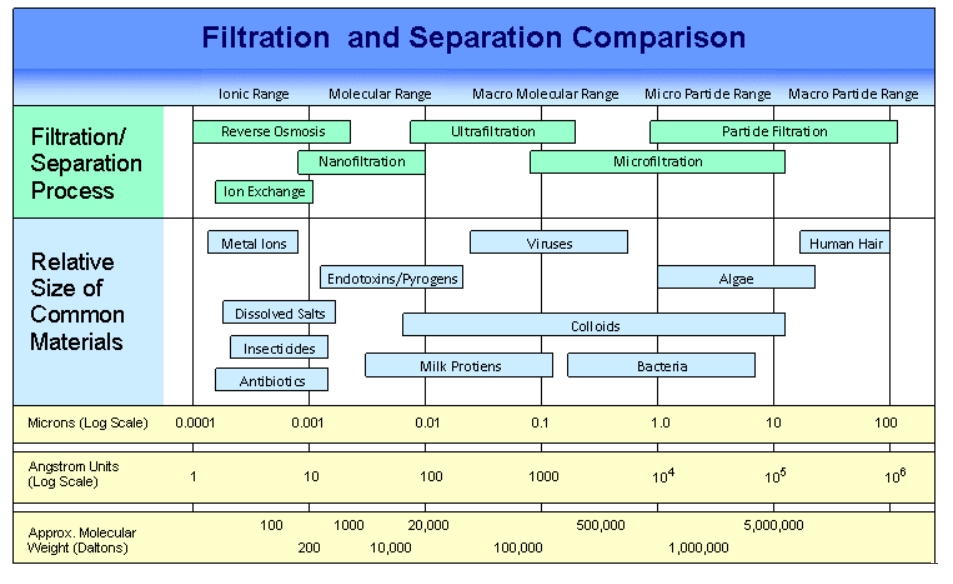
It is clear from the water filtration particle removal chart above to what extent the different water purification methods are successful. Many people complain that reverse osmosis removes minerals from water and in a way they are correct. Reverse Osmosis or R.O as its commonly called removes up to 98% of the chemical content of the water. This you can measured with a TDS meter and while Ultra Filtration and Nano filtration are also both membrane based technologies their results cannot be accurately measured with a TDS meter. UF does not remove chemicals to a molecular level. it’s speciality is fine suspended solids removal or colloidal removal.
If you want a fine membrane purification method with enhanced purity without losing all the mineral content then Nano membrane purification is the choice. The best of both worlds.
While Easy Water Solutions PTY offers the entire range of water purification , filtration and water treatment our focus is on the areas around waste water treatment specifically. If you want solutions to acidic or limescale problems then please visit our hard water : limescale solution and soft water pages
Both of these sections deal with the effects of ph levels on water and the subsequent problems that these can cause and how to remedy them.
Call Michael on 081 811 8051 for Water Purification or fill in the form at the top of the page